Two-Wire Irrigation Repair: Why Decoder Systems Fail and How the Fault Gets Found
Quick answer: Most two-wire irrigation repair calls come down to one damaged spot on the shared wire path: a nick from digging, a corroded splice, a lightning surge or a failed decoder. Because every zone shares the same pair of wires, one fault can knock out several zones at once. We find it by testing the path from the controller and splitting it into sections, so only the bad spot gets dug up. Automatic Rain repairs two-wire and decoder systems on all brands across Memphis and Shelby County.
Two-wire (decoder) systems run many of the larger irrigation systems around Memphis: HOA common areas, apartment complexes, shopping centers, churches and municipal sites. They save a lot of wire, but when something goes wrong, the troubleshooting is different from a regular sprinkler system.
How a two-wire irrigation system works
On a conventional system, every valve has its own wire running back to the controller, plus a shared common wire. A property with 40 zones can have a thick bundle of wire in the trench. A two-wire system replaces that bundle with a single pair of wires that runs past every valve. At each valve, a small decoder listens for its own address and opens the valve when the controller calls for it. Manufacturers build entire commercial lineups around this design, including the Hunter EZ Decoder System and Rain Bird two-wire controllers, because it cuts wire and trenching on big sites.
The trade-off is that every zone depends on the same wire path. A conventional system usually fails one zone at a time. A two-wire system can lose a whole section, or the whole property, from a single damaged spot.
Signs your system needs two-wire irrigation repair
- Several zones stopped working at the same time, often in one area of the property
- The whole system went down after a thunderstorm
- The controller shows a fault, alarm or high-current warning on the wire path
- Zones turn on by themselves, run erratically, or work one day and not the next
- One zone won’t open even though the controller says it’s running
- Problems started right after landscaping, fencing, utility or drainage work
6 common causes of two-wire irrigation problems
1. Lightning and power surges
Summer thunderstorms are part of life in the Mid-South, and lightning is one of the most common reasons decoders and controller modules fail. SiteOne’s wire path troubleshooting guide points out that when a decoder is damaged by a strike or surge, the wiring should be checked before parts are swapped, or the same failure comes right back. That’s also why manufacturers spell out surge protection and grounding. Rain Bird, for example, calls for a line surge protector about every 500 feet of two-wire path on its ESP-LXD controllers.
2. Wire cut or nicked during digging
Fence posts, tree planting, aeration, utility work and new drainage lines all cross wire paths. A clean cut stops the zones past the break. A nick is sneakier: water reaches the copper and the fault grows over weeks.
3. Corroded or loose splices
Every decoder connection is a splice. If it wasn’t made with a waterproof, grease-filled direct-burial connector, moisture gets in, corrosion builds and the path starts leaking current.
4. Earth leakage from damaged insulation
When insulation breaks down, current escapes into wet soil. Memphis clay holds moisture, so a leak can make zones act strangely long before anything fails outright. SiteOne’s guide to fixing a wire fault recommends tracking down earth leakage first, because it can hide other faults.
5. A failed decoder or solenoid
Sometimes the wire is fine and a single decoder or valve solenoid has simply died. Many decoders have status lights, and some can be checked with a handheld tool, such as Hunter’s EZ-DT decoder diagnostic tool. That helps confirm the bad part before it gets replaced.
6. Programming and address errors
Each decoder has an address. If a decoder was replaced and not addressed correctly, or the controller was reprogrammed, the right zone may never get the command. This is the first thing to rule out because it’s the cheapest fix.
How we handle two-wire irrigation repair
Good two-wire irrigation repair is about narrowing the problem down before anyone digs. Here’s how our crew does it, in plain language:
- Check the controller first. We confirm the programming, decoder addresses and any alarms. Which zones fail, and where they sit on the property, is the first clue.
- Test the wire path at the controller. We take voltage and current readings to see whether there’s a short, an open or leakage. Some controllers, like Rain Bird’s ESP-LXD, have a built-in short-finding mode for this step.
- Split the path into sections. By opening the path at valve boxes and splice points and measuring with a clamp-on meter, we cut the search area in half again and again. Done this way, wires rarely need to be cut just to test them.
- Pinpoint the spot. Our wire locator and fault finder trace the path underground to the exact fault, so we only dig one small hole.
- Make a lasting repair. We splice damaged wire with waterproof direct-burial connectors and replace and address any failed decoders or solenoids.
- Retest every zone. We run each zone from the controller, confirm normal current draw and mark the repair on the property map.
Two-wire irrigation repair on all brands
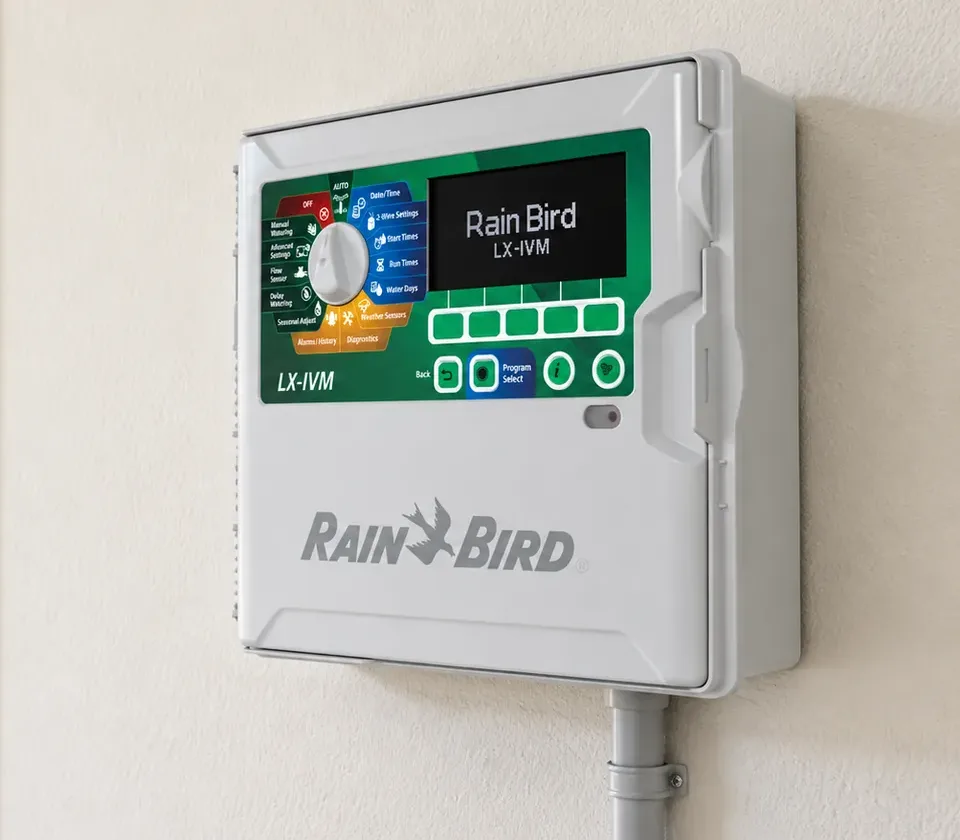
Automatic Rain works on two-wire and decoder systems from all brands, including Rain Bird and Hunter. Whether it’s an older controller at an apartment complex or a newer smart controller at an HOA entrance, the troubleshooting steps above stay the same. If your property has a map or as-built drawing of the wire path, have it ready, because it speeds up every repair. If it doesn’t, ask about an irrigation design plan. For everything else we handle on larger sites, see our commercial irrigation services and sprinkler repair pages.
Planning a new two-wire system or a big expansion? Read our guide to two-wire irrigation installation in Memphis.
How to prevent two-wire problems
- Call before digging. Contact Tennessee 811 before any digging. 811 marks utility lines, not private irrigation wire, so also show your landscaper or contractor where the wire path runs.
- Keep a map of the wire path and decoder locations with the property records.
- Check surge protection and grounding against the manufacturer’s specs.
- Fix shorts and leaks quickly. Moisture and corrosion make a small fault worse over time.
- Watch the system after big storms or site work, and call if zones start acting up.
Need two-wire irrigation repair in Memphis?
Automatic Rain repairs two-wire and decoder systems on all brands for HOAs, apartment complexes, shopping centers, churches, municipalities and homes across Memphis and Shelby County. Tell us which zones are down and what changed on the property, and we’ll handle the two-wire irrigation repair from start to finish.
Request a free quote Call 901-521-9112Frequently asked questions
Why did several zones stop working at once?
On a two-wire system, every zone shares one pair of wires. A cut, short or bad splice on that path can stop every zone past the damage, or the whole path, at the same time. When only one zone fails, a decoder or solenoid is the more likely cause.
Can lightning damage a two-wire irrigation system?
Yes. Lightning and power surges are a common cause of failed decoders and controller modules. Manufacturers call for surge protection and grounding, and the wiring should be checked after a strike before parts are replaced.
Do you have to dig up the whole wire to find a fault?
No. We test the path from the controller, split it into sections and use our wire locator and fault finder to pinpoint the spot, so usually only a small area gets dug.
Which brands does Automatic Rain cover for two-wire irrigation repair?
All brands, including Rain Bird and Hunter decoder systems, on commercial properties and homes across Memphis and Shelby County.
Should I repair or replace an old two-wire system?
Most two-wire problems are repairable: a damaged section of wire, a bad splice or a failed decoder. Replacing the whole system is rarely the first step. A repair visit shows which situation you’re in.